Reduce participation friction
Plan around travel, timing, registration, technology, communication, and physical access before inviting people to participate.
Local knowledge. Practical access. Clear boundaries.
Plan nonclinical wellness education and outreach around the realities of rural communities: distance, transportation, broadband, trusted relationships, accessible communication, and the capacity of local organizations.
Unified Wellness Project supports education, outreach, resources, and community collaboration. We are not a clinic, telehealth provider, transportation service, government agency, or grantmaker, and we do not promise program placement or health outcomes.
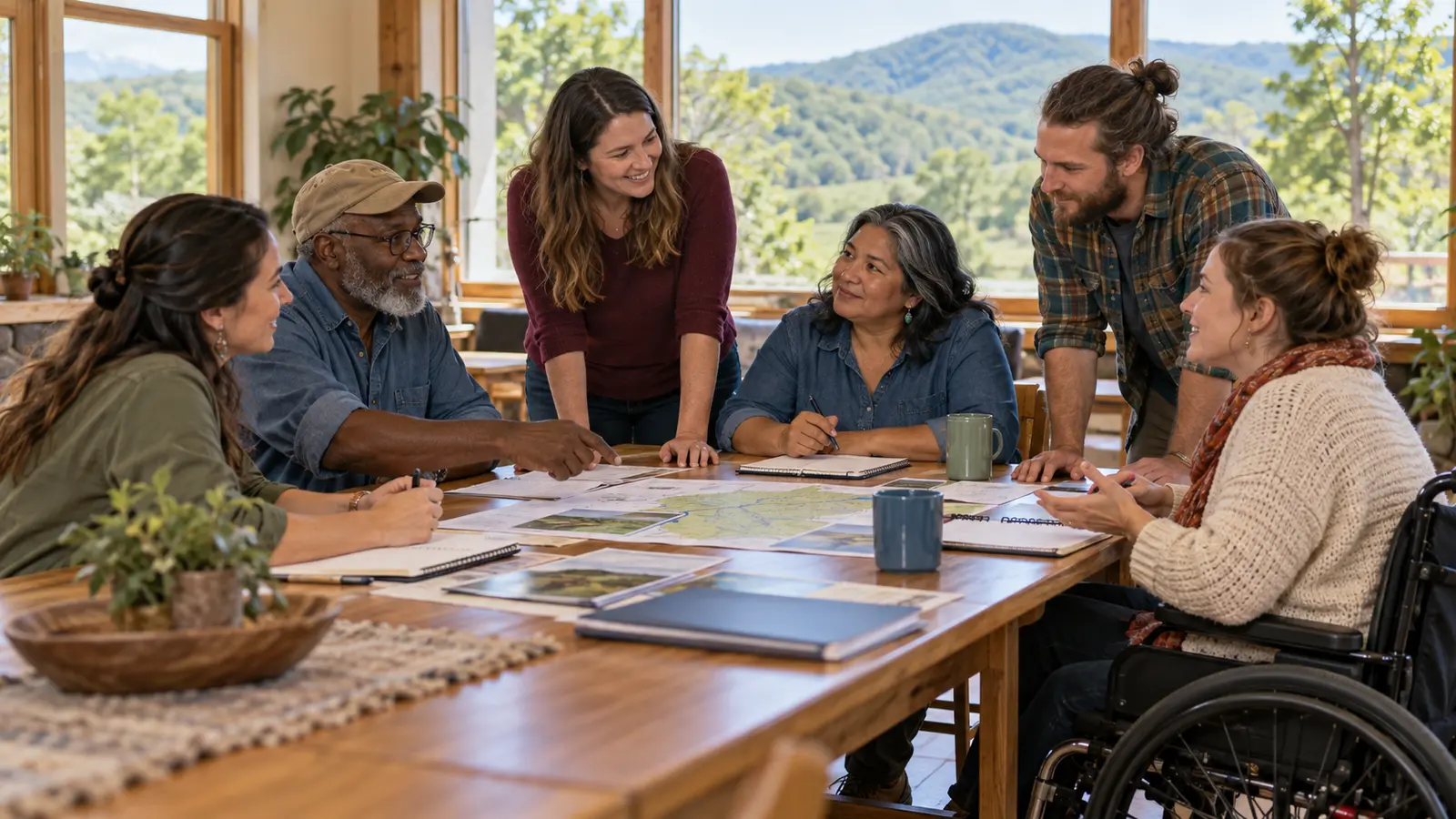
Design with place in mind
A rural wellness program is a community-based effort that shares practical, nonclinical wellness information or connects people with useful resources in a rural setting. The right format may be a workshop, printed guide, phone-based follow-up, resource table, partner-led outreach activity, or a blended approach. The program should be shaped by the people it is meant to serve rather than imported from a larger city without adaptation.
Rural communities are not all alike. Travel distance, road conditions, public transportation, internet access, work schedules, disability access, language, caregiving responsibilities, weather, and trust in institutions can affect participation in different ways. A useful plan begins with local listening and an honest picture of what the organizing group can support. For statewide context, Virginia organizations can consult the Virginia State Office of Rural Health and then pair public information with direct community input.
Plan around travel, timing, registration, technology, communication, and physical access before inviting people to participate.
Identify trusted messengers, familiar gathering places, existing programs, practical knowledge, and organizations already serving the community.
Choose one realistic education or outreach goal, define what the program will not do, and create a clear next step for questions outside its role.
A distinct planning lens
A general outreach plan may assume that people can travel to a central venue, complete online forms, stream a presentation, or attend during standard business hours. Rural planning tests those assumptions. It asks how far people may need to travel, whether a mobile signal or home internet connection is reliable, whether printed or phone-based options are needed, and whether the proposed venue and schedule fit local routines.
This page complements UWP’s broader guidance on health equity programs, accessible wellness education, and language access planning. Its specific purpose is to help Virginia organizations apply those principles in rural settings without treating rural residents as a single audience or defining a community only by barriers.
A practical seven-stage process
Use these stages as a planning framework, not a promise of a particular service. Each stage should identify who makes the decision, what information supports it, and how residents can influence the next step.
Name the nonclinical education or outreach goal, intended community, geographic scope, and decision the program should help people make. Avoid trying to solve every wellness need at once.
Ask residents and local organizations what information is useful, what barriers affect participation, which channels they trust, and what previous efforts should not be repeated.
Review gathering places, communication networks, existing programs, transportation realities, internet access, accessible facilities, and referral resources. Public data can guide questions but cannot replace local knowledge.
Compare in-person, print, phone, digital, pop-up, and hybrid options. The most polished format is not useful if people cannot reach it, use it, or ask questions in a way that works for them.
Document who coordinates logistics, reviews information, supports accessibility, responds to questions, protects privacy, and makes referrals. Separate education from diagnosis, treatment, eligibility decisions, and emergency response.
Test the participant journey with a limited activity or review group. Check directions, timing, materials, technology, accommodations, contact options, and the next step before expanding the approach.
Track whether people could find, reach, understand, and use the activity. Invite feedback in more than one way, record unresolved barriers, and revise the plan without claiming a clinical outcome.
Plan the whole participant journey
The Health Resources and Services Administration notes that rural access is shaped by factors such as population, travel time, transportation, geographic isolation, broadband, and local economic conditions. Its rural health resources can help organizations frame planning questions. For community education, the practical test is whether a person can move from first hearing about the activity to a useful next step without encountering an avoidable barrier.
Is the venue familiar, physically accessible, and reachable? Are directions clear for people coming from different parts of the service area? Is there a useful option when travel is not practical?
Can someone learn about the activity, register, participate, and receive follow-up without a smartphone or reliable broadband? Are phone, print, and accessible digital alternatives available when needed?
Does the schedule account for shift work, school, caregiving, farming seasons, and travel? Have trusted community voices helped shape the invitation, content, and feedback process?
Choose the right partnership
Unified Wellness Project can discuss mission-aligned opportunities involving nonclinical wellness education, accessible materials, community outreach, resource navigation, volunteer support, and partnership planning. A conversation may begin with the community, the intended audience, the education goal, the access barriers already identified, and the roles each organization can realistically hold.
A planning conversation is exploratory. It does not confirm a program, event, funding award, staffing level, geographic placement, or delivery schedule. Visit Partnerships to review UWP’s partnership approach, browse Resources, or use the contact page to describe a rural wellness education or outreach idea.
Use current public guidance
The Virginia State Office of Rural Health provides statewide rural-health information and planning resources. The HRSA Rural Health hub organizes federal information on rural access and programs. The CDC rural health resource page brings together research, planning, and public-health materials. The USDA Rural Data Gateway offers data and program-discovery tools. Use these sources to inform questions, then verify current details with the responsible agency and local partners.
For a local resource inventory, use UWP’s guide on how to create a community resource guide. Keep entries dated, identify the source, and confirm referral details before sharing them. Public programs, eligibility rules, contact information, and funding opportunities can change.
Continue the planning work
Frequently asked questions
A rural wellness program is a community-based effort that shares practical wellness education, supports healthy-living choices, or helps people navigate useful resources in a rural setting. It can use in-person, print, phone, digital, or blended formats. A responsible program defines its scope clearly and does not imply medical care when it is educational and nonclinical.
Start with one useful goal, listen to residents and local organizations, map existing assets and access barriers, choose a reachable format, assign clear roles, pilot the participant journey, and review access and usefulness. The plan should reflect local geography, communication habits, schedules, transportation, broadband, accessibility, and organizational capacity.
Common planning questions involve travel distance, transportation, venue accessibility, broadband and mobile coverage, work and caregiving schedules, language access, disability communication access, privacy, weather, and trust. The relevant barriers differ by community, so planners should avoid relying on a generic rural checklist alone.
Yes. Depending on local needs and capacity, options may include printed materials, telephone information, in-person sessions, community bulletin channels, radio or other local communication, and downloadable resources that do not require continuous connectivity. The program should give people a clear way to ask questions and receive updates through more than one channel.
Include residents from the intended community and organizations or informal leaders who understand local conditions. Depending on the goal, that may include educators, libraries, faith communities, disability advocates, food-access organizations, local agencies, volunteers, caregivers, or other trusted groups. Participation should not be treated as an endorsement or assumed partnership.
Use measures that match the program’s actual role, such as whether people could find, reach, understand, and use the activity; which access supports were requested; whether materials were useful; and what barriers remained. Avoid claiming clinical improvement unless qualified evaluators use an appropriate method and the organization is authorized to make that claim.
No. Unified Wellness Project is not presented as a clinic, medical provider, or telehealth service. UWP focuses on nonclinical wellness education, outreach, practical resources, volunteering, and community partnership planning. Medical questions and urgent concerns should be directed to qualified providers or emergency services.
A grounded first conversation
Tell Unified Wellness Project who you hope to reach, what nonclinical wellness information may be useful, and which access barriers or partnership roles still need clarification. We can explore whether an education, resource, or outreach planning conversation fits UWP’s mission and capacity.