Build a useful community asset map by defining a clear purpose, inviting residents, documenting formal and informal strengths, and keeping information current.
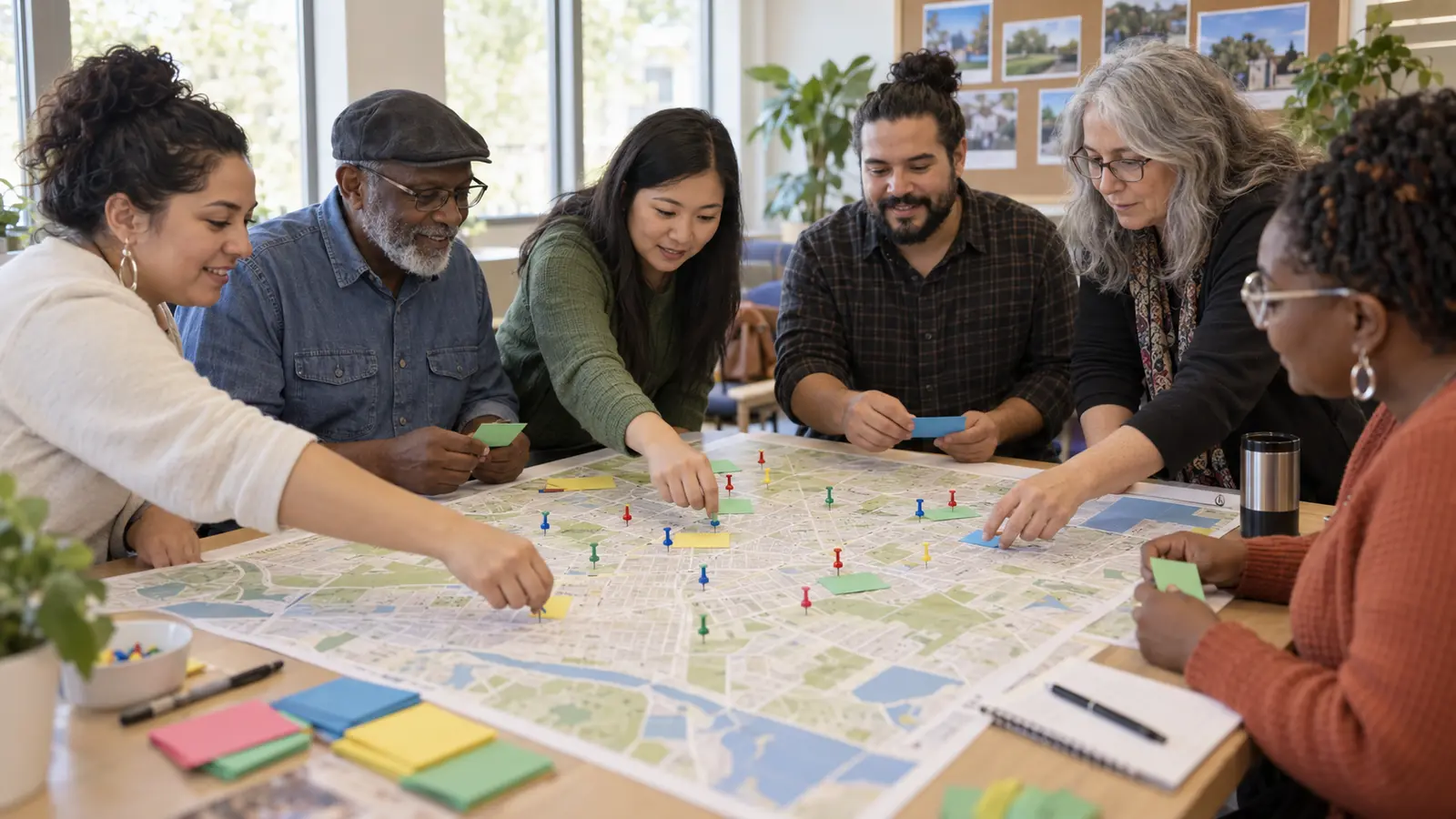
Community asset mapping is a strengths-based process for identifying the people, places, organizations, relationships, knowledge, and practical resources that already support a community. The finished “map” may be geographic, but it can also be a spreadsheet, directory, network diagram, or set of annotated notes.
The goal is not to prove that a community has no needs. It is to understand what is already present, who can access it, how assets connect, and where residents see opportunities for stronger coordination. A useful map is built with people, not simply about them.
Before collecting information, write one sentence explaining what the map will help people decide. Examples include choosing outreach locations, identifying partners for a wellness workshop, improving a resource guide, or understanding which neighborhoods have few transportation options.
A narrow purpose keeps the project manageable. “Map everything helpful in the county” is difficult to define and maintain. “Identify free or low-cost places where residents can access wellness information in three neighborhoods” gives the team clearer boundaries.
Community asset mapping complements a needs assessment but does not replace one. A needs assessment asks what conditions or barriers deserve attention. Asset mapping asks what strengths, relationships, and resources could help address those priorities. UWP’s community needs assessment guide explains the difference in emphasis.
Decide whether “community” means a neighborhood, town, school area, cultural group, network, or another shared context. Geographic boundaries alone may miss people who belong through language, identity, work, caregiving, or shared experience.
List what the project will include and exclude. A map for community wellness planning might include parks, libraries, food access points, transit routes, meeting spaces, community groups, trusted messengers, informal mutual support, and resident skills. It does not need to become a public directory of every person or organization.
Invite people who understand the community from different positions: residents, volunteers, local staff, people who use community resources, and people who face access barriers. Compensate participation when the project has resources to do so, and offer more than one way to contribute.
Agree on how decisions will be made, which information may be public, and who will maintain the map. Do not treat one resident as a spokesperson for an entire neighborhood or identity group.
Begin with a flexible set of categories. These may include individuals’ skills, resident associations, nonprofit and faith groups, public agencies, businesses, physical spaces, cultural knowledge, transportation, communication channels, and sources of funding or equipment.
The U.S. Department of Education’s overview of creating an asset map notes that there is no one-size-fits-all list because location and context matter. Leave room for residents to name assets that do not fit the initial categories.
Use several methods when possible: small conversations, a short survey, a workshop, a walk-through, phone calls, and review of existing public information. Explain the purpose in plain language and tell people how their input will be used.
Offer non-digital options, accessible meeting locations, readable materials, and ways to request communication support. The Department of Justice guidance on effective communication emphasizes that the appropriate aid or service depends on the person, the communication, and the context.
For an organization or public resource, confirm the name, website or contact method, service area, access requirements, hours when relevant, cost information, and the date checked. Use primary sources such as the organization’s own website or a direct conversation.
Public datasets such as data.census.gov can add context, but they do not show every informal resource or explain how residents experience access. Treat administrative data and lived experience as different kinds of evidence.
Ask permission before publishing a person’s name, contact details, home-based activity, or informal role. Do not map sensitive locations or describe a resource as safe, accessible, free, available, or culturally responsive unless that information was verified and dated.
When a listing may change quickly, publish a general contact route rather than personal information. Keep private working notes separate from the public version, limit access, and delete information that is no longer needed.
Review the map with residents. Ask which assets already collaborate, which are difficult to reach, which communities are missing from the process, and where information is duplicated or outdated. A dot on a map does not prove meaningful access. Transportation, language, eligibility, cost, hours, disability access, trust, and digital access all affect whether a resource can be used.
Do not turn the map into a ranking of organizations. The purpose is to understand relationships and options, not to declare winners or certify quality.
Include a “last checked” date, a correction method, and a named role—not necessarily a person—responsible for review. Set a realistic schedule based on how quickly the information changes. A simple quarterly check may be more sustainable than promising real-time accuracy.
Share the result in the formats people actually use: a printable list, a screen-reader-friendly web page, a large map for meetings, or a spreadsheet for partners. Keep the original purpose visible so the map does not quietly expand beyond its evidence.
Explore UWP’s Community Outreach, Partnerships, Resources, and Volunteer pages for other ways to support community-led planning.
It is a collaborative process for identifying and organizing the strengths, resources, relationships, skills, and places that already support a defined community. The result can be geographic or non-geographic.
Define a purpose and community, invite resident guidance, choose flexible categories, collect information through accessible methods, verify public details, protect privacy, review connections and gaps, and assign a maintenance plan.
Assets may include people’s skills, resident groups, trusted relationships, organizations, public services, businesses, gathering places, transportation, equipment, cultural knowledge, communication channels, and funding sources.
A needs assessment focuses on priorities, conditions, and barriers. Asset mapping focuses on existing strengths and resources. Used together, they can connect a documented priority with realistic local capacity.
No. A spreadsheet, directory, relationship diagram, or annotated list may work better when the important assets are people, networks, knowledge, or services without one fixed location.
Set a schedule based on how quickly the information changes and the team’s capacity. Always show the date checked and provide a way for residents or organizations to submit corrections.
No. Personal contact details, sensitive locations, informal support roles, and unverified claims may need to remain private. Publish only what is useful, accurate, permitted, and safe to share.
Write the one decision your map should support, then invite three people with different community experiences to review that purpose before you collect any names or locations. UWP offers education and planning resources; it does not certify mapped organizations or guarantee that listed services are available.