Listen
Learn which questions, barriers, strengths, and trusted relationships community members identify.
Community voice • practical education • accessible participation
Community health promotion works best when it starts with local priorities and makes practical information easier to use. Unified Wellness Project helps Virginia organizations think through accessible, nonclinical education and outreach that can connect people with trustworthy guidance, everyday wellness skills, and community resources—without replacing medical care or promising outcomes.
Important boundary: UWP provides general wellness education and community-resource guidance, not diagnosis, treatment, clinical services, or a promise that a specific program, service, partnership, or health result will be available.
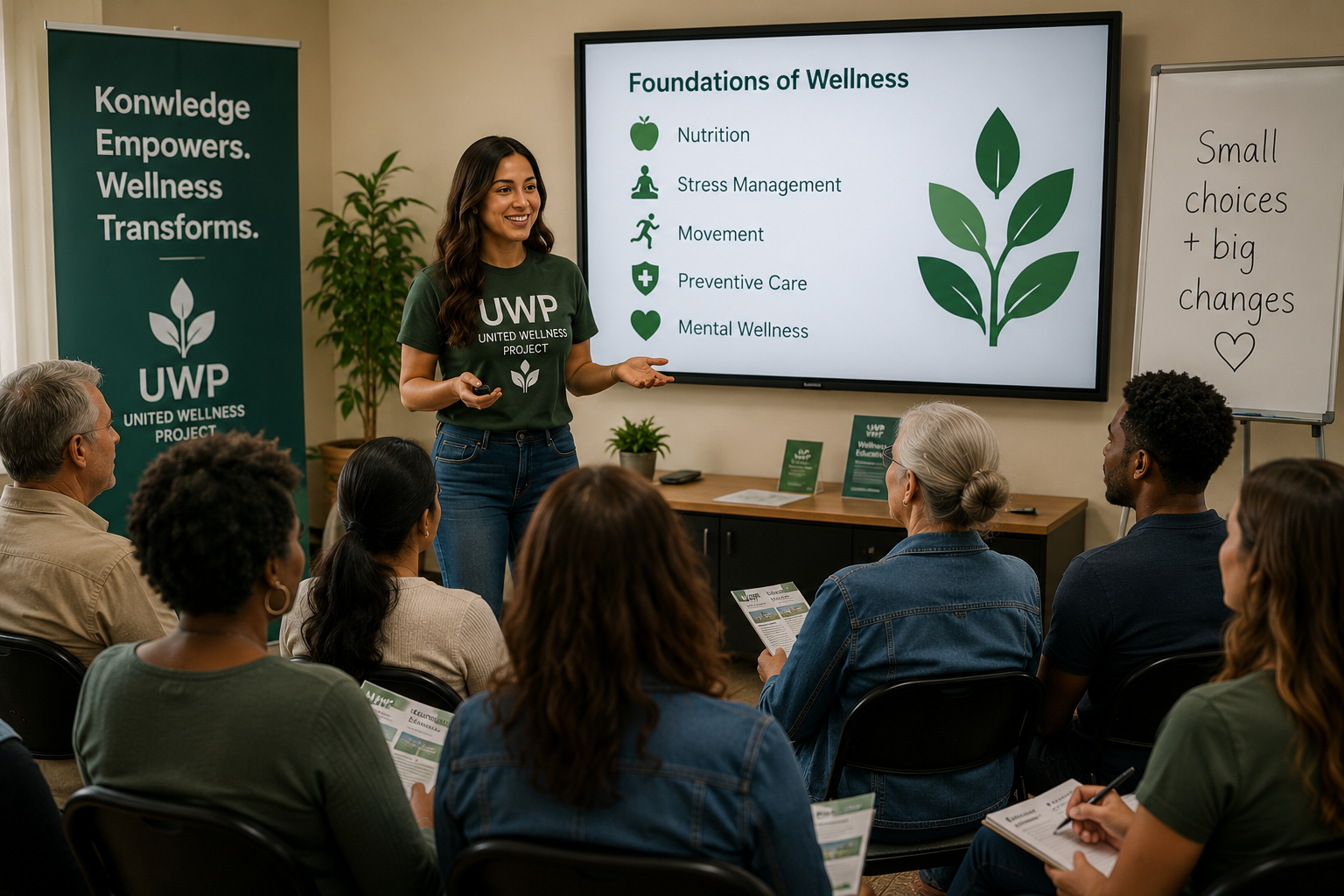
Learn which questions, barriers, strengths, and trusted relationships community members identify.
Define a realistic purpose, responsible roles, credible sources, access needs, and a safe referral boundary.
Gather useful feedback, examine reach and clarity, and revise before expanding an activity.
A practical definition
Community health promotion supports people and organizations in creating conditions that make everyday wellness information and opportunities easier to reach and use. Healthy People 2030 notes that health is shaped by the places where people live, learn, work, play, worship, and age—not only by individual choices. Responsible planning therefore considers community priorities, access, environment, partnerships, and clear limits as well as educational content.
Ask people what would be useful before selecting a topic or format. A neighborhood group, library, family-serving organization, workplace, school community, or faith community may describe different goals and barriers. Listening also helps a planner identify trusted messengers and perspectives that have not yet been included.
Plan physical access, effective communication, readable materials, scheduling, transportation, technology, language access, sensory needs, and more than one way to take part. Accessibility is not an add-on after invitations have been sent; it is part of the program design.
General education can build practical knowledge, help people prepare questions, and point toward reliable public resources. It should not diagnose, recommend individual treatment, determine eligibility, pressure participants, or present attendance as evidence of a health outcome.
Useful program pathways
A focused program is usually more useful than a broad promise to “improve health.” Choose one audience, one practical purpose, and a manageable activity that can be reviewed and improved.
Use short lessons, familiar words, current primary sources, and a clear next step. When a group is still defining priorities, UWP’s community needs assessment guide offers a practical starting point.
Discuss realistic ways to add movement and social connection while respecting different abilities, schedules, transportation options, caregiving responsibilities, and access to safe spaces. Offer choices instead of presenting one routine as the right fit for everyone.
Make room for food cost, storage, kitchen access, transportation, cultural preferences, allergies, and time. Education can explain trustworthy guidance and practical planning, while community partners may help identify current local resources without guaranteeing availability.
Use official guidance to explain everyday topics such as handwashing, indoor air, fall prevention, safe water, medication disposal, or emergency planning. Keep general prevention information separate from personal screening, diagnosis, or treatment decisions.
Help people identify what a resource does, who it is intended to serve, what information it requests, how to ask for communication support, and how to confirm current details. A listing should not be presented as an endorsement, eligibility decision, or promise of service.
Define roles, boundaries, training, access responsibilities, and a feedback route before recruiting help. The Journal guide to building nonprofit community partnerships can support early conversations about shared purpose and accountability.
A practical planning framework
Talk with intended participants and community-facing staff before finalizing the topic. Ask which questions repeat, what has already been tried, what formats feel useful, what barriers appear, and who is missing from the conversation. Describe the group without treating it as one uniform audience.
Write a purpose that participants can recognize, such as “practice checking the source and update date of a wellness claim” or “identify two accessible ways to join a neighborhood walking activity.” Avoid a vague promise to make people healthier or solve a complex access problem through one event.
Prefer the public agency or primary organization responsible for the guidance. Check the update date, intended audience, and limits of the source. Distinguish established guidance from local practice or opinion, and document exactly which links or materials were used.
Consider location, physical access, captions, interpretation, accessible electronic and print formats, sensory needs, transportation, timing, caregiving, cost, technology, and alternatives to live participation. Review UWP’s accessibility commitment and name an access contact before outreach begins.
Write down who owns the content, who checks sources, who facilitates, who answers access questions, who protects participant information, and where individual clinical or urgent questions should go. State what the activity will not provide so expectations stay clear.
Test a short lesson, resource table, discussion, or outreach activity before scaling it. Give participants a practical action to try, allow time for questions, and observe where instructions, navigation, or access break down. A small pilot can reveal useful changes without implying success from attendance alone.
Ask whether people could identify the main message, complete the intended practice, find the next step, and participate with needed access. Gather both numbers and comments when appropriate. Use the findings to revise the activity, document limitations, and decide whether another cycle is justified.
Evidence-informed planning
These sources add structure to program planning while keeping this page educational and nonclinical.
A practical framework for assessing context, describing a program, gathering credible evidence, and acting on findings.
HHS explains why conditions where people live, learn, work, play, worship, and age matter to health and well-being.
A checklist for audience, purpose, organization, familiar words, active voice, headings, lists, and usable presentation.
Official guidance on communication access and appropriate auxiliary aids and services for covered organizations.
Roles and next steps
Before inviting participation, write down the purpose, audience, roles, content source, access plan, information practices, feedback method, and nonclinical boundary. A clear scope helps organizations explain what is being offered without overstating availability or likely results.
Bring the community question, intended audience, current materials, preferred format, access needs, timing, and any required review process. If you are exploring a broader relationship, review UWP’s partnership information.
Share the questions and barriers that matter most. UWP’s resources and Community Wellness Journal offer educational starting points, while Get Involved outlines ways to connect.
Use the contact form to describe the community, educational need, access considerations, desired next step, and who is already involved. UWP can review mission fit; an inquiry does not guarantee availability, a service, funding, or a formal partnership.
Frequently asked questions
A health promotion program is an organized set of activities intended to help people build knowledge or skills and to make supportive information, environments, or opportunities easier to reach. Community programs may include education, outreach, resource navigation, or partnership activities. UWP’s role is limited to accessible, nonclinical education and planning.
Start by listening to the intended community, naming one practical purpose, reviewing credible evidence, planning access, assigning roles and boundaries, choosing a manageable activity, and deciding how usefulness will be evaluated. Design should reflect local context rather than copying a program without checking fit.
Implementation begins with a written scope, current materials, responsible roles, an access and communication plan, outreach that accurately describes the activity, and a clear route for questions. Pilot the activity, document what happened, protect participant information, and adjust based on credible feedback.
Examples include plain-language workshops, resource navigation, walking-group planning, food-access education, safer-home information, wellness communication, volunteer training, and community outreach. The appropriate activity depends on the audience, purpose, evidence, access needs, partner roles, and available capacity.
Use measures that match the purpose and program stage. You might examine reach, accessibility, understanding, completion of a practice task, referral use, participant feedback, or implementation barriers. Attendance and satisfaction can be useful process information, but they do not prove a medical or long-term health outcome.
Evaluation helps an organization understand whether the activity reached the intended people, was accessible, communicated clearly, used resources responsibly, and needs revision. It also makes limitations visible and supports better decisions about whether to continue, change, or stop an activity.
No. Health promotion may include education, outreach, supportive environments, or community action, while primary health care includes clinical services delivered by qualified providers. UWP is not a medical clinic and does not provide diagnosis, treatment, individualized medical advice, or clinical care.
Start with one community priority
Tell UWP who the activity is for, what people need to understand or practice, what would make participation accessible, and what role your organization can take. We can review whether a next conversation fits the mission.