An eight-step guide for planning a supervised walking school bus with safer routes, clear roles, accessible participation, reliable communication, and a small pilot.
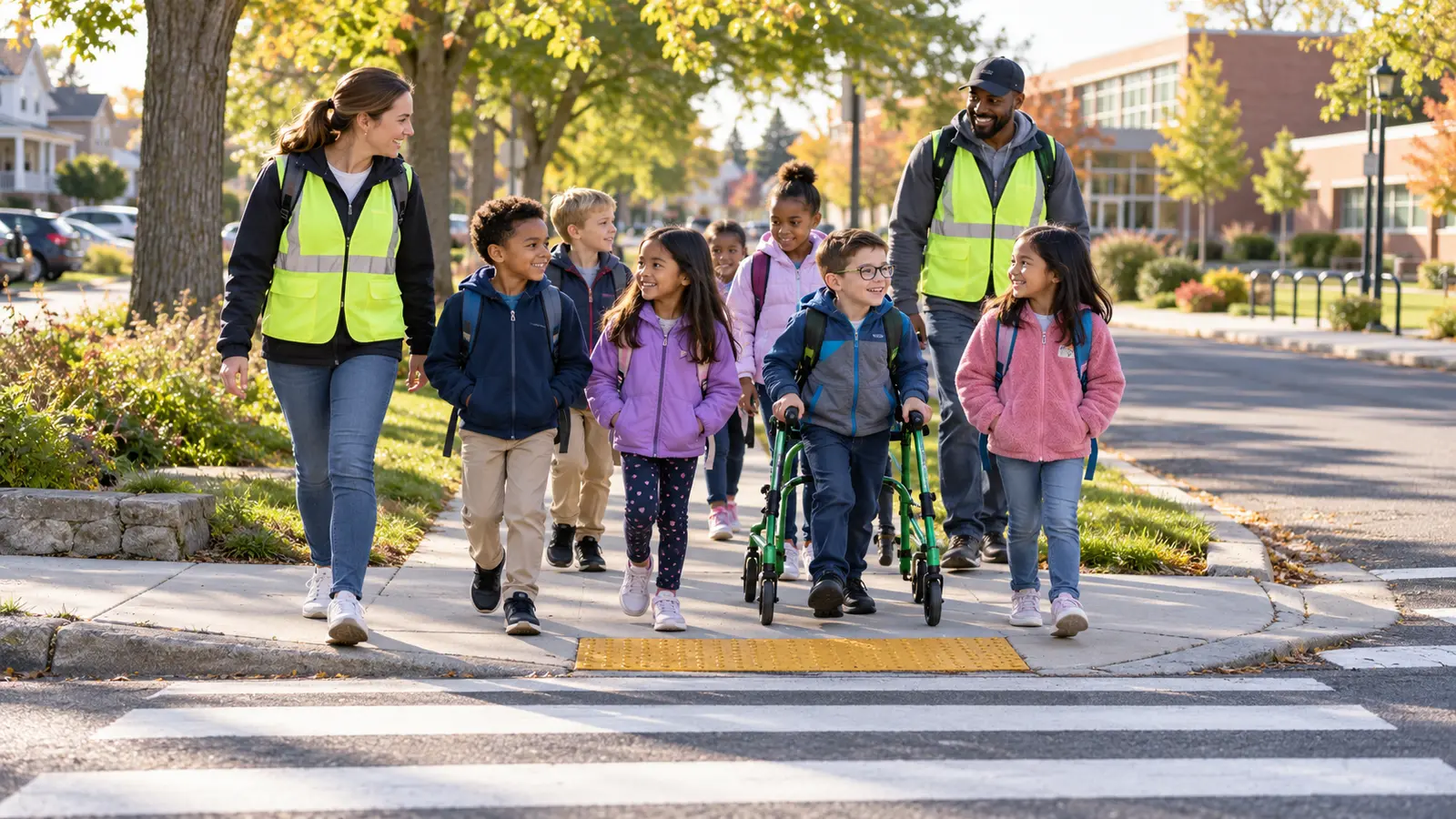
A walking school bus is a group of children walking to school with one or more responsible adults along an agreed route and schedule. It can be as small as two households taking turns or a more organized neighborhood effort with meeting points. The “bus” is the group; the route, stops, adults, and expectations provide structure.
A successful walking school bus begins with safety and reliability, not group size. Families, schools, neighborhood groups, and community organizations should plan together, follow school and local requirements, and avoid presenting a route as risk-free. The Federal Highway Administration’s Safe Routes to School guide provides education, mapping, crossing-guard, and inclusion resources that can support local planning.
Start with a small conversation among families and the school. Ask whether a walking group would be useful, which mornings or afternoons matter, and what concerns families have. Identify the school contact and learn about arrival procedures, attendance, transportation rules, volunteer screening, insurance, permission forms, and weather closures.
Be precise about what the group is and is not. A neighborhood volunteer effort may not be an official school program. Do not use the school’s name, logo, student information, or communication systems without permission. Clarify who makes decisions, who may participate, and where adult responsibility begins and ends.
Collect only the information needed to explore a route. A general intersection or potential meeting point may be enough at first; avoid circulating children’s names and home addresses broadly. Plot likely origins, the school entrance, sidewalks, crossings, traffic signals, crossing guards, steep grades, construction, drainage, lighting, and places where people can wait without blocking access.
One long route is not always the best answer. Two shorter branches, a “park and walk” meeting point, or different schedules may reduce complexity. Families who live too far away may still join at a designated stop.
Adults should inspect the route on foot during the expected school-travel period. Conditions can differ from a midday map: traffic may queue across crossings, driveways may be busy, buses may block views, and sidewalks may narrow. The NHTSA Walkability Checklist recommends involving schools, community members, local officials, and transportation professionals when evaluating walking conditions.
Record specific issues without promising that volunteers can fix roadway design. For concerns involving signals, crossings, sight distance, speed, or missing pedestrian facilities, contact the appropriate school or public agency. A walking school bus should use the safest practical route available, even if it is not the shortest.
Ask families what would support participation. A child may need a slower pace, mobility-device clearance, a quieter meeting point, visual directions, a communication aid, medication carried by an authorized adult, or an alternate plan for fatigue. Check curb ramps, sidewalk width and condition, crossing time, surface changes, construction detours, and accessible school entry.
A child should not have to disclose more personal information than necessary. Plan accommodations with the family and school according to their policies. When one route cannot meet every need, explore a different joining point, schedule, or participation role rather than assuming the child cannot be included.
Assign a lead walker and a rear adult when group size and age make that appropriate. Adults should know the route, roster, stops, communication plan, crossing expectations, and what to do if a child does not arrive. Set a maximum group size based on ages, route complexity, and school rules—not a universal ratio copied from another program.
Create backup coverage before launch. A same-day cancellation without a verified handoff can leave families expecting supervision that is not present. Volunteers should never assume responsibility beyond what they agreed to, and children should not be added informally without guardian permission.
Keep instructions short and observable: arrive before departure time; stay with the group; walk rather than run; stop at the curb; cross only when the adult says it is time; follow crossing-guard directions; keep driveways clear; and use respectful behavior. Adults model the same practices.
Plan for dogs, bicycles, scooters, headphones, phones, siblings, and personal belongings. If any are not compatible with the route or group, say so in advance. The NHTSA child pedestrian curriculum includes lessons on walking near traffic, crossings, intersections, parking lots, and school-bus safety.
Choose one reliable channel for schedule changes and define a cutoff time for cancellations. State who sends the message and how receipt is confirmed. Protect family contact information and avoid public posts that reveal children’s regular routes and times.
Agree on conditions that cancel or change the walk, such as school closure, severe weather alerts, unsafe heat or cold, poor air quality, ice, flooding, or construction. Identify shelter points and a family reunification process. Adults should carry essential contacts and know how to call emergency services, but the group should not represent itself as providing medical care.
Run a small pilot with a short route and limited schedule. Observe arrival time, crossing delays, group spacing, stop locations, accessibility, and adult workload. Invite concise feedback from children, families, volunteers, and the school. Record incidents and near misses factually, then decide whether to adjust, pause, or expand.
Expansion should follow demonstrated capacity. A dependable one-day-a-week group is more useful than a daily promise the volunteer team cannot sustain. Rewalk the route when seasons, construction, school procedures, or traffic patterns change.
Walking groups can connect transportation, healthy routines, volunteering, and neighborhood problem-solving. For related planning, see UWP’s guide to improving pedestrian safety, the Community Outreach program, and the Volunteer page. Schools and community organizations exploring a coordinated effort can also use UWP’s Partnerships page and Get Involved hub as next steps for conversation—not as a guarantee that a walking-school-bus program is currently available.
It is a group of children walking to school with responsible adults along a planned route and schedule, often with designated meeting points.
There is no universal number. Consider children’s ages and needs, group size, crossings, route complexity, school rules, and local requirements. Many groups use a lead and rear adult when feasible.
No, but families should clarify whether it is a school program, a parent-led activity, or a community effort. Permission, naming, volunteer, privacy, and arrival rules may differ.
Map likely origins, inspect options on foot at the real travel time, use controlled crossings and sidewalks where possible, and work with transportation professionals on infrastructure concerns.
Set cancellation thresholds and a communication process before launch. Consider school closures, severe weather, heat, cold, air quality, ice, flooding, visibility, and local alerts.
Ask the family what supports are useful, inspect the route for access barriers, allow a suitable pace and communication method, and consider alternate stops or schedules when needed.
Not necessarily. A weekly or limited pilot lets the group test the route, volunteer capacity, and communication before making a larger commitment.