Use an accessible neighborhood walk audit to document crossing, visibility, speed, sidewalk, and transit-access concerns and request practical follow-up.
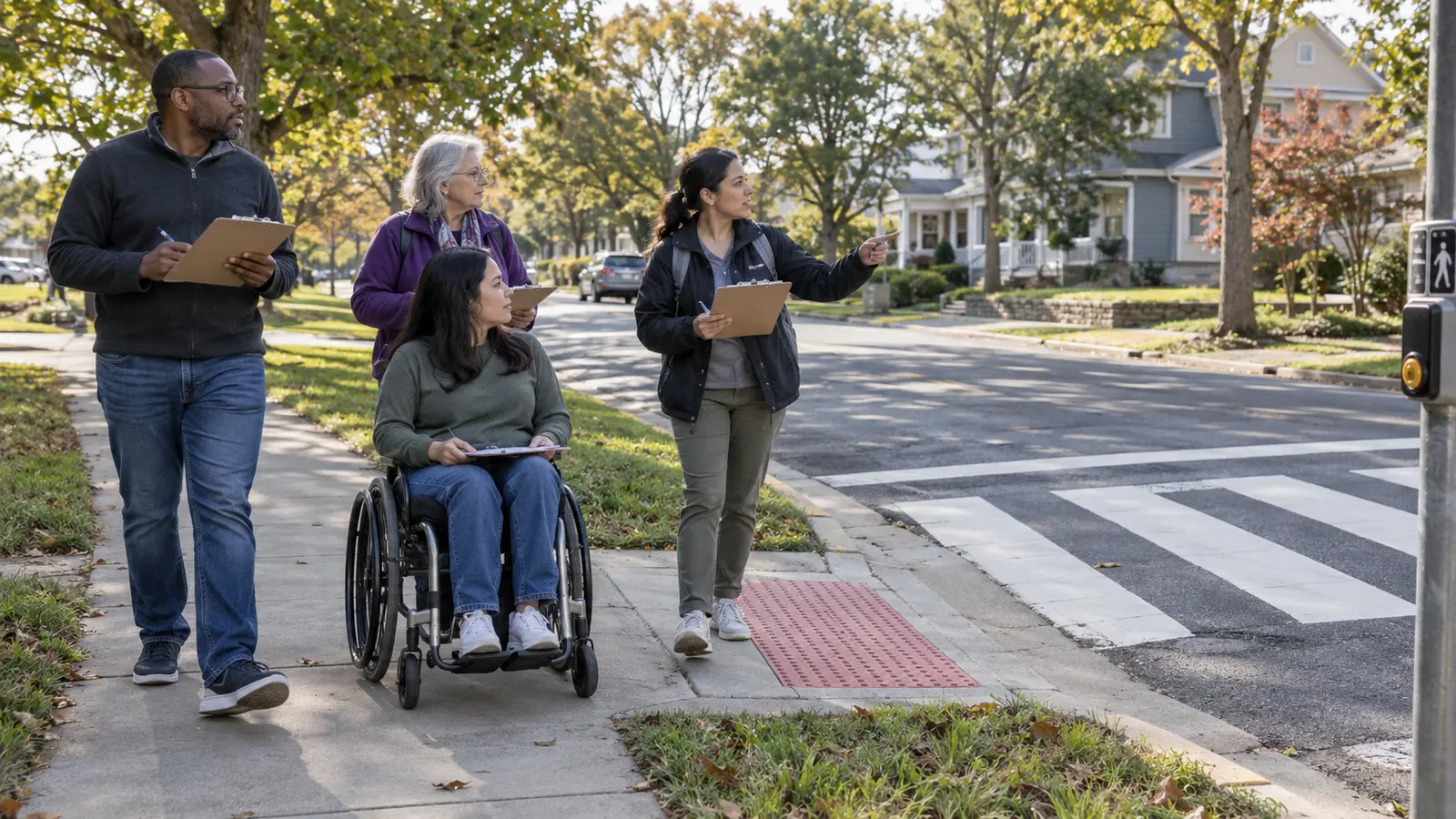
People notice a neighborhood differently when they walk, roll, push a stroller, wait for a bus, or help a child cross a street. A route that looks fine from a car may include a missing curb ramp, a blocked sight line, a long crossing, a dark bus stop, or traffic moving too fast for the conditions.
This guide explains how to improve pedestrian safety in your neighborhood by conducting an accessible walk audit, documenting what people experience, and bringing specific observations to the agency or property owner responsible for the location.
Choose a route people actually use: the walk to a school, park, grocery store, library, community center, transit stop, or neighborhood entrance. Keep the first audit short enough to complete carefully.
Write one purpose statement, such as: “Identify barriers that make it difficult to walk or roll between the apartment entrance and the bus stop.” A focused question helps the group collect useful evidence instead of producing a general list of frustrations.
Do not trespass, direct traffic, block sidewalks, or place signs or equipment in the roadway. An audit observes conditions; engineering and traffic-control decisions belong to the responsible public agency or qualified property owner.
Invite residents who use the route in different ways, including older adults, parents, youth, people with disabilities, transit riders, and people who walk at different times of day. Do not ask one person to represent an entire group.
Offer an indoor or virtual way to contribute for anyone who cannot join the walk. Provide the route, timing, expected distance, terrain, restroom information, weather plan, and contact person in advance. Ask what accommodations are needed.
UWP's accessible community event guide can help with communication, registration, sensory needs, and participation choices.
Bring a printed or digital map, clipboards or phones for notes, a camera if participants consent, reflective clothing when appropriate, water, and any personal mobility or weather supplies. Decide who will lead, record, photograph conditions, and watch the group.
Use pairs when possible. Stay on sidewalks or other lawful pedestrian areas. Cross only where and when it is safe and legal. If a condition is too risky to inspect closely, document it from a safe location.
Record what happens, where, and when. “Cars were moving fast” is less useful than “Drivers did not appear to yield while three people waited at the marked crossing at 4:15 p.m.” Avoid estimating vehicle speed unless a qualified process is used.
Note weather, daylight, traffic level, school dismissal, deliveries, construction, or another condition that may affect the observation. One visit is a snapshot, so repeat the audit at different times when the concern varies.
Look for a continuous path that people can use without entering traffic. Document:
The U.S. Access Board's public right-of-way accessibility guidance is a technical resource for planners and agencies. Residents can document barriers without attempting to determine code compliance themselves.
At each crossing, look at whether people can see approaching vehicles and whether drivers can see people waiting to cross. Parked vehicles, vegetation, signs, curves, hills, and poor lighting can limit visibility.
Record the crossing distance, number of lanes, presence of a median or refuge, markings, signs, signals, curb ramps, and how long people wait. When there is a pedestrian signal, notice whether people with different walking speeds can reasonably complete the crossing during the displayed interval; report concerns rather than testing the limit in traffic.
NHTSA's pedestrian-safety guidance covers walking and driving behaviors and emphasizes shared responsibility among road users.
Document behaviors that affect safety: failure to yield, fast turns, rolling stops, blocked crosswalks, distracted driving, passing a stopped vehicle, or vehicles backing across a walking route. Record patterns, not license plates or personal accusations, unless an official reporting process specifically requests that information.
Street design and operating speed influence behavior. Community education can help, but reminders alone do not replace safe design, appropriate speeds, and consistent maintenance.
A daytime audit cannot show every nighttime problem. Return after dark with appropriate safety precautions or invite people who regularly use the route at night to contribute.
Look for dark crossings, glare that makes people difficult to see, broken lights, shadows from vegetation, and stops where someone must wait outside a lit area. Note the exact pole, intersection, or address range so the responsible agency can locate it.
A safe route should connect to the places people need to reach. At a bus stop, check the approach, waiting area, curb access, lighting, seating, schedule information, and connection to the crossing. A technically accessible stop is still hard to use if there is no safe route to it.
At schools, parks, stores, and community buildings, observe parking-lot crossings, drop-off areas, driveway conflicts, and the path from the public sidewalk to the entrance. Ask the property owner before entering nonpublic areas.
Create one record for each concern:
Separate urgent hazards from long-term planning ideas. For immediate danger, contact the appropriate emergency or public-safety channel rather than waiting for a report meeting.
Residents can describe the problem and desired outcome clearly: a continuous accessible route, better visibility, a safer crossing, slower operating speeds, or repaired lighting. Engineers and agencies can evaluate which treatment fits the road, traffic, right-of-way, standards, and budget.
The Federal Highway Administration's proven safety countermeasures explains treatments used by transportation agencies. Link to a relevant resource when communicating with officials, but avoid claiming a treatment is appropriate before a site-specific review.
Send a concise report to the correct department, association, school, transit provider, or property manager. Include a contact person and ask how the concern will be tracked. Save the case number or response.
Revisit the route after maintenance, construction, a seasonal change, or an agency response. Record what changed and what remains. Thank participants and share the result in an accessible format, including when no immediate project is approved.
Use UWP's community needs assessment steps to place walk-audit findings in a broader listening process. Explore Healthy Living, Community Outreach, and the Partners page for mission-aligned ways to support healthier communities.
It is a structured observation of a route by people who walk or roll there. Participants document sidewalks, crossings, visibility, speed, lighting, transit access, and other conditions for follow-up.
Invite people with varied experiences, including residents, older adults, youth, parents, people with disabilities, transit riders, and property or agency representatives when appropriate.
Check sight lines, crossing distance, markings, signals, curb ramps, waiting space, lighting, turning conflicts, driver yielding, and whether people can complete the crossing safely.
Identify the agency or property owner responsible, provide the exact location and observed condition, attach privacy-safe photos if useful, request an inspection, and keep the case number.
Not without authorization. Signs, markings, traffic devices, and work in the public right-of-way require approval from the responsible agency.
Repeat it when conditions vary by time, weather, school schedule, construction, or season, and after a reported issue is repaired or reviewed.
No. It creates organized community evidence for review. The responsible agency must evaluate safety, design, ownership, standards, funding, and competing needs.
This article provides general community-planning and safety education. It is not engineering, legal, accessibility-compliance, or emergency advice. Follow local rules and use qualified professionals and public agencies for site-specific decisions.