Eight organization-level strategies can make wellness information easier to find, understand, discuss, and use across languages, abilities, and everyday settings.
Health information can be technically accurate and still be difficult to find, understand, or use. Long forms, unfamiliar terms, unclear next steps, inaccessible websites, and information available in only one language can all create barriers.
Learning how to improve health literacy in a community begins with a shift in responsibility. Organizations should not assume that people simply need to “try harder” to understand complex systems. They can design clearer information, easier processes, and more respectful opportunities to ask questions.
Healthy People 2030 distinguishes personal health literacy from organizational health literacy. Its health literacy framework emphasizes both people’s ability to use information and organizations’ responsibility to help them do so equitably.
Community health literacy is not a reading test. It is the result of people, information, relationships, and systems working together. In a health-literate community, residents can locate trustworthy information, understand the main message, identify a realistic next step, ask questions without embarrassment, and recognize when professional help may be appropriate.
Nonprofits, libraries, schools, faith communities, public agencies, neighborhood groups, and local media can all contribute. They do not need to provide clinical care. Their role may be to make education easier to access, connect people with reliable sources, and improve how information is communicated.
Ask the intended audience what questions they have, where they currently look for answers, what makes information hard to use, and which formats they prefer. Include people with disabilities, people who use languages other than English, people with limited internet access, older adults, caregivers, and others often left out of planning.
Listening can be simple: short interviews, a table at an existing event, a small discussion, or a review of frequently asked questions. Explain how the input will be used and do not collect diagnoses or other private information when it is unnecessary.
Lead with what a person needs to know or do. A flyer about a wellness workshop should begin with the topic, who it is for, date, time, location, cost, access information, and registration step. Background about the organization can come later.
Use descriptive headings so readers can scan. Replace vague buttons such as “Learn more” with labels such as “See workshop access details” or “Find reliable nutrition resources.”
Plain language is accurate communication organized around the audience’s needs. The CDC’s plain-language checklist recommends putting the most important message first, using familiar words, keeping sentences focused, and breaking information into logical sections.
Define unavoidable technical terms immediately. Use “high blood pressure” before “hypertension,” for example, and explain what the term means without oversimplifying. Plain language should preserve nuance, uncertainty, and source information.
Readable communication uses sufficient color contrast, clear type, meaningful link text, captions for video, headings in logical order, alternative text for informative images, and documents that work with assistive technology. Avoid putting essential instructions only inside an image.
Offer non-digital options when possible. A mobile-friendly webpage may still be inaccessible to someone without reliable data service. Printed copies, phone information, and help from a trained person can close practical gaps.
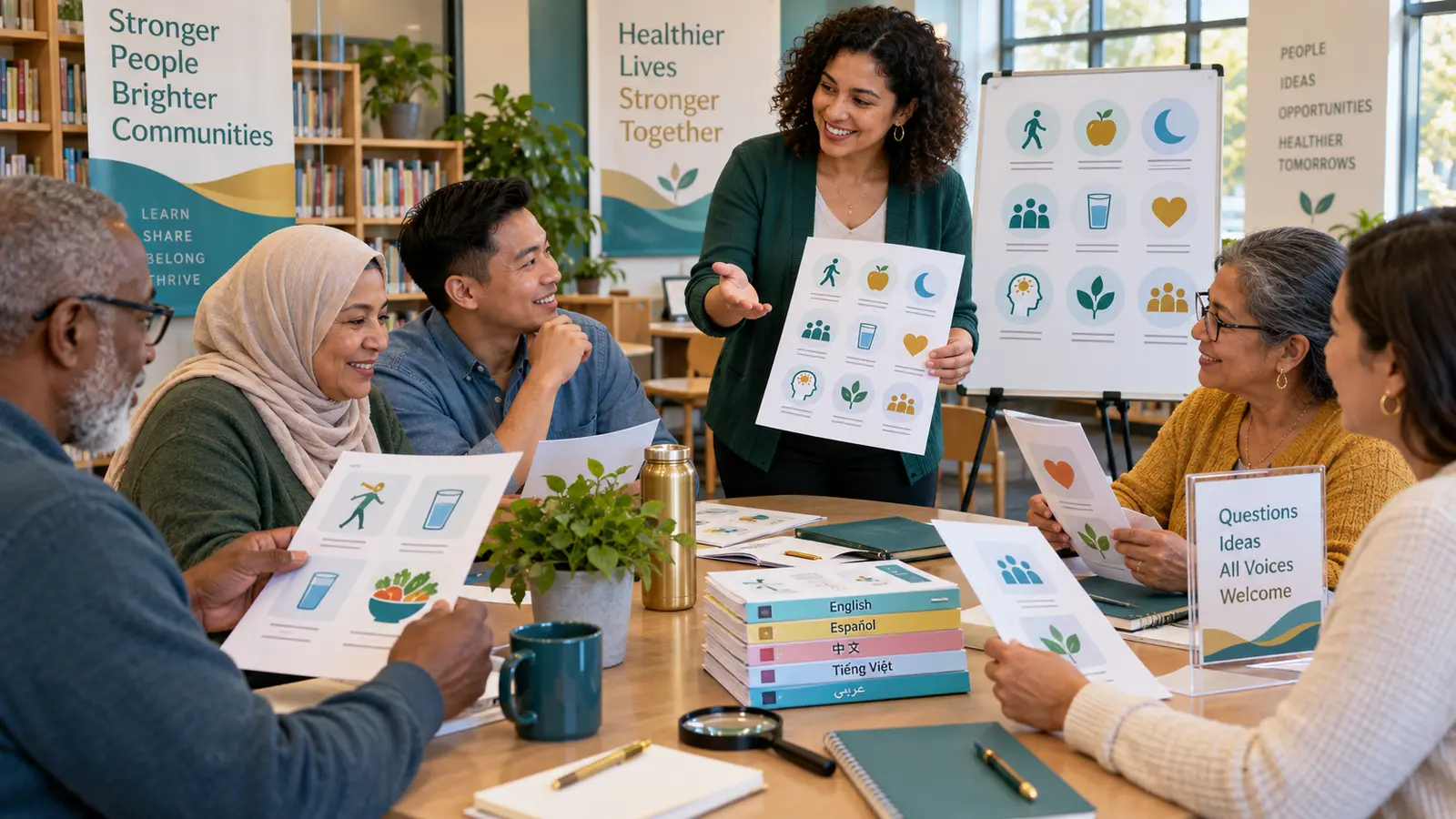
Translation works best when it is planned before the English version is finalized. Budget for qualified translation or interpretation, identify priority languages through community input and local evidence, and leave room in layouts because translated text may be longer.
A bilingual volunteer can help residents feel welcome, but complex or sensitive communication may require a qualified interpreter. Do not ask children to interpret private adult information. Give community reviewers time to check whether translated material is natural, respectful, and locally understandable.
People often act on information when it comes through relationships they trust. Partner with librarians, community health workers, neighborhood leaders, disability organizations, educators, cultural groups, and other messengers whose roles genuinely fit the subject.
Trust should not be treated as a distribution channel to borrow. Invite messengers into planning, credit their knowledge, clarify responsibilities, and compensate time when resources allow. Give them source notes and a contact for questions instead of asking them to improvise answers.
Ask a few members of the intended audience to find a fact, explain the main message in their own words, and complete the next step. Watch where they hesitate. Questions such as “What would you do next?” reveal more than “Do you like it?”
Testing is not a judgment of participants. It is a test of the material and process. Revise the content when several people miss the same point. Keep a record of what changed and why.
Health guidance changes. Put a review date and source links on educational materials, assign an owner, and remove outdated copies. Provide a phone number, email address, or short form for corrections and accessibility requests.
Respond without defensiveness. A resident who flags an unclear sentence, broken link, or missing language option is helping the organization improve.
Before publishing a wellness resource, ask:
Link to primary sources and explain why each source matters. Avoid dropping a long reference list on readers without context. One well-placed link to current federal guidance can be more useful than several unexplained links.
The CDC’s health literacy overview offers a starting point for public-health communicators. For everyday readers evaluating claims, UWP’s guide to finding reliable health information online provides a seven-question check.
A page view or brochure count does not show whether information was usable. Choose measures tied to the purpose, such as the percentage of test participants who can find the next step, the number of repeated clarification requests, completion of an accessible registration process, or whether requested formats were available on time.
Collect the minimum information needed and protect privacy. Report limitations honestly. If only a small convenience group tested a resource, say so rather than describing the results as representative of an entire community.
Unified Wellness Project’s Wellness Education program focuses on practical, accessible learning. Browse Resources, explore community wellness workshops in Virginia, or visit Partner With Us to discuss mission-aligned collaboration.
Personal health literacy is a person’s ability to find, understand, and use health information and services. Organizational health literacy is how well an organization helps people do those things equitably.
People encounter health information through schools, media, workplaces, nonprofits, public agencies, libraries, and community relationships. Clearer systems and trusted local communication can make information easier to use.
They can share well-sourced education, use plain language, improve accessibility, offer navigation to appropriate resources, host learning opportunities, and create respectful ways for residents to ask questions.
No. Good plain language removes unnecessary complexity while keeping important conditions, uncertainty, and source context. Oversimplification is different from clarity.
Test it with members of the intended audience. Ask them to find information, describe the main message, and show what they would do next. Revise the material when the same barriers appear repeatedly.
Plan language access at the beginning, use qualified translators or interpreters appropriate to the content, and ask community reviewers to check meaning and usability. Automated translation may help with a draft but should not be the only review for important guidance.
Set a review date based on how quickly the subject changes and review sooner when authoritative guidance changes. Name an owner who can update links, dates, and claims.
This article provides general educational information. It is not medical, legal, public-health, translation, or accessibility advice for a specific situation.