
Use the Air Quality Index to plan outdoor activity, understand color categories, reduce exposure, and communicate changes without unnecessary alarm.
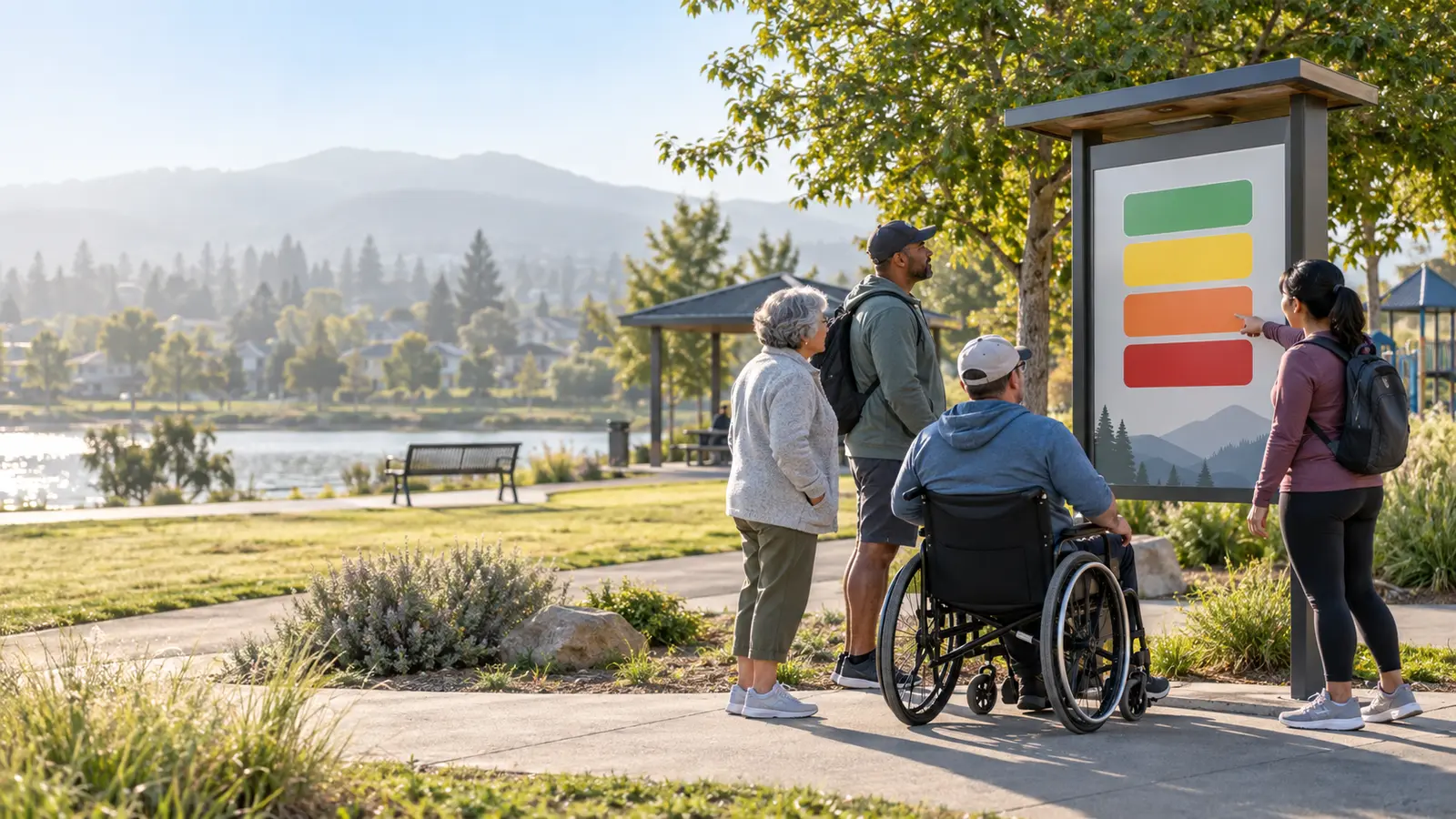
The Air Quality Index, or AQI, turns outdoor air-monitoring data into a color and number that can help people plan a walk, practice, volunteer day, outdoor class, or community event. It is a planning tool, not a diagnosis and not a measure of every possible air concern.
The U.S. Environmental Protection Agency and partner agencies provide the national AirNow AQI basics. Before an outdoor activity, check current conditions and the forecast for the specific place and time. Then use the information to make a proportionate adjustment instead of assuming every air-quality alert requires the same response.
The AQI reports outdoor air quality for five major pollutants regulated under the Clean Air Act: ground-level ozone, particle pollution, carbon monoxide, sulfur dioxide, and nitrogen dioxide. A location can have more than one pollutant reading. The reported AQI is generally driven by the pollutant with the highest index value at that time.
The number is paired with a color category. Lower values mean lower pollution levels and generally less concern; higher values indicate a greater chance that exposure could affect health. The same AQI value can call for different choices depending on the activity, its duration, the people attending, and whether the reading is current, forecast, or based on a nearby monitor.
A color alone is not the whole decision. Read the category description, identify the main pollutant when available, and follow state or local public-health instructions. AirNow’s activity guides translate AQI categories into suggestions for outdoor activity.
Look up the location where the activity will happen, not only your home address. Air quality can vary across a region because of smoke, traffic, terrain, wind, and monitor location. If a group will travel, check the destination as well as the starting point.
Review both the current AQI and the forecast. Conditions can change during the day. Ozone may be higher during hot, sunny afternoons, while smoke and particle pollution can shift quickly with weather and fire conditions. Recheck close to the activity rather than relying on yesterday’s screenshot.
Outdoor activity guidance can differ for ozone and particle pollution. A general AQI color is useful, but the pollutant detail explains why the reading is elevated and which groups may need extra care. The EPA’s guidance on using the AQI for particle pollution can help planners understand the index.
A gentle, short activity is different from a long run, field cleanup, or sports practice. Invite participants to make their own choices without asking them to disclose a diagnosis. Children, older adults, pregnant people, people with heart or lung conditions, and people who are active outdoors may receive different public guidance depending on the pollutant.
When conditions are elevated, planners can change one or more parts of the activity:
Do not present one adjustment as appropriate for everyone. People should be able to choose an alternative or leave without penalty. A person who develops symptoms should stop the activity, move to cleaner air, and follow their personal care plan or seek appropriate medical help.
Write the plan before an event. Identify who checks conditions, which source is used, when the decision is made, who has authority to change the plan, and how participants will be notified. Use the same process for staff, volunteers, and attendees.
A practical plan might set review points at the start of the day and shortly before the activity. It can name flexible options at each level without promising that a single number always produces the same decision. Severe weather, heat, visibility, local alerts, wildfire smoke, transportation, and building conditions can also matter.
For a public event, pair this work with UWP’s accessible community-event guide. Describe the alternative format in advance, keep notices readable, provide a phone or email contact, and avoid requiring participants to explain private health information.
A useful message answers five questions: What is the current or forecast AQI? Which pollutant is driving it? What part of the activity is changing? What options do participants have? When will the next update be shared?
Use plain language such as: “The forecast AQI for tomorrow afternoon is orange because of particle pollution. We are moving the walking portion indoors and offering a seated route. We will recheck at 9 a.m. and post any change here.” Avoid dramatic language, unexplained numbers, or claims that an indoor space is completely free of pollution.
The AQI describes outdoor air. It does not directly measure indoor particles, mold, carbon monoxide, cleaning chemicals, or ventilation. Outdoor smoke can enter buildings, and indoor sources can create their own concerns. For home and community spaces, review UWP’s indoor air-quality guide as a separate planning step.
When moving an activity indoors, consider whether the space can accommodate the group, whether doors or windows are bringing in polluted air, and whether the ventilation or filtration approach fits building guidance. Do not use ozone-generating devices as a substitute for proven air-cleaning practices.
Explore more practical planning through UWP’s Healthy Living program, Wellness Education, Resources, and guide to planning physical activity.
The AQI is a nationally used, color-coded index for reporting outdoor air pollution. Higher numbers indicate more pollution and a greater possibility of health concern.
An AQI from 0 to 50 is in the green “Good” category. Conditions can still vary by pollutant and location, so people with a personal care plan should continue to follow it.
An AQI of 100 is at the upper end of the Moderate category. Most people can continue usual activities, while unusually sensitive people may consider reducing prolonged or heavy exertion.
There is no single cancellation number for every activity. Consider the pollutant, duration, intensity, participants, official guidance, and available alternatives. Higher categories call for progressively stronger changes.
No. It reports outdoor air conditions. Indoor air depends on outdoor air entering the building, ventilation and filtration, indoor sources, and the building itself.
Check when planning, again on the day of the activity, and close to the start time when conditions are changing. For a long event, assign someone to monitor updates.
Use AirNow.gov or an official state or local air-quality agency. Consumer sensors can add context, but their readings may not be equivalent to regulatory monitors.
This article provides general wellness education and is not medical advice. Follow official alerts and a qualified health professional’s guidance for individual symptoms, conditions, medications, or activity limits.