Find trustworthy information
Use plain-language materials, show where guidance comes from, explain when it was updated, and separate general education from individual medical advice.
Worker-informed • Accessible • Nonclinical
A useful employee wellness program starts with the realities of work—not a one-size-fits-all challenge. Unified Wellness Project invites Virginia employers, nonprofits, and community organizations to explore practical wellness education shaped by employee priorities, accessible participation, and clear nonclinical boundaries.
Unified Wellness Project is a wellness-education nonprofit, not a medical clinic, occupational-health provider, insurer, benefits administrator, or emergency service.
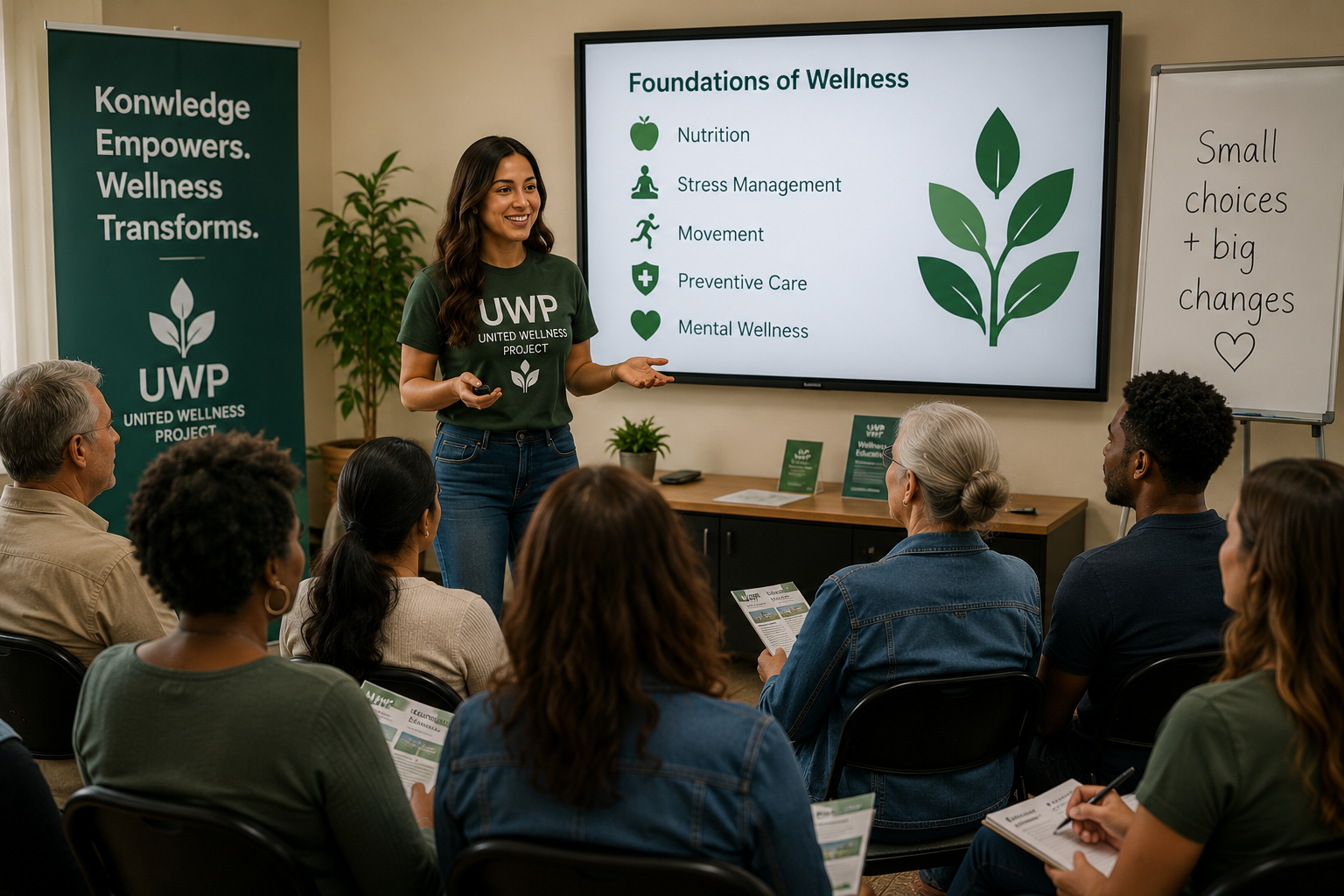
A stronger starting point
Wellness education cannot compensate for unsafe work, unmanageable demands, inadequate rest, discrimination, or barriers to using existing benefits. A responsible plan looks first at the conditions people work in and treats education as one part of a broader approach.
The CDC’s National Institute for Occupational Safety and Health describes Total Worker Health as an approach that integrates protection from work-related safety and health hazards with injury- and illness-prevention efforts. It prioritizes a hazard-free work environment and considers how the organization of work affects well-being.
For UWP, that means keeping a clear role: offer or help plan accessible, evidence-informed education; listen to employee priorities; and point organizations toward qualified safety, benefits, legal, clinical, or crisis resources when a need falls outside educational scope.
Useful before ambitious
Education works best when it answers a defined question and gives people a realistic next step. Depending on employee input and organizational fit, a plan might focus on:
Use plain-language materials, show where guidance comes from, explain when it was updated, and separate general education from individual medical advice.
Explore small, adaptable habits related to movement, food access, sleep routines, stress awareness, digital boundaries, or social connection without presenting one ideal lifestyle.
Make it easier to identify appropriate public agencies, crisis contacts, benefit channels, and local supports while protecting privacy and avoiding unsupported referrals.
Offer multiple formats and meaningful alternatives so employees are not excluded by schedule, disability, language, location, technology, or caregiving demands.
Any topic should be reviewed for audience, source quality, organizational role, and accessibility before it is offered. UWP does not diagnose, treat, prescribe, screen employees, or promise outcomes.
A practical planning path
Write one sentence explaining what the organization is trying to learn or improve. “Choose a useful first education topic” is clearer than “fix employee wellness.”
Use an anonymous survey, small facilitated conversations, or a representative working group. Ask about useful topics, barriers, preferred formats, scheduling, and what employees do not want.
Identify whether the issue is really an education gap or whether workload, staffing, scheduling, safety, leave, equipment, supervision, or policy needs attention from the appropriate internal leaders.
Keep participation voluntary where appropriate, collect only information that is genuinely needed, explain how feedback will be used, and avoid asking employees to disclose diagnoses or personal health details.
Consider captions, readable materials, interpretation, accessible rooms, remote and non-digital options, paid participation time, shift coverage, sensory needs, and a way to request accommodations.
Test one topic and one or two formats with a defined audience. Confirm facilitator roles, source review, logistics, referral boundaries, and how questions outside scope will be handled.
Measure reach, accessibility, relevance, clarity, and what employees would change. Do not imply health improvement, cost savings, retention, attendance, or productivity gains without appropriate evidence and a sound evaluation design.
Participation without pressure
Employees should be able to understand what a program is, who is providing it, whether participation is optional, what information will be collected, and who can see that information. That clarity matters before registration—not only after someone asks.
Accessible communication can include plain language, usable digital documents, captions, interpretation, high-contrast materials, readable type, advance agendas, quiet participation options, and more than one way to ask a question. The U.S. Department of Justice effective-communication guidance explains that communication access depends on the nature, length, complexity, and context of the exchange.
Connect the work
Explore plain-language learning built around practical questions and trustworthy sources.
Consider realistic everyday habits without perfectionism or guaranteed health outcomes.
Connect education to community context, access barriers, and responsible resource pathways.
Review UWP’s commitment to clearer, more usable, and more inclusive participation.
An organization can also browse the Resources hub and Community Wellness Journal before contacting UWP. Existing materials may help clarify the audience, question, and next step.
Frequently asked questions
It is an organized effort related to worker health or well-being. Programs vary widely and may include education, policies, benefits, safety efforts, resource navigation, or clinical services. UWP’s role is limited to nonclinical wellness education and community connection.
Start by defining a specific purpose, listening to employees, reviewing working conditions, setting privacy and access standards, and identifying which team owns decisions outside education. Pilot one focused activity before expanding.
Useful plans often include employee input, leadership responsibility, safe working conditions, voluntary and private participation where appropriate, accessible formats, trustworthy information, referral boundaries, and a method for evaluation and revision.
Results depend on the goal, program design, working conditions, participation, and evaluation method. Education may improve access to understandable information, but UWP does not promise medical, financial, retention, attendance, or productivity outcomes.
Ask employees what is useful, reduce schedule and access barriers, communicate the purpose and privacy rules clearly, offer more than one format, make participation respectful, and show how feedback changed the plan.
Many educational activities are best offered without pressure. Requirements can depend on the activity and applicable rules. Organizations should obtain appropriate legal, human-resources, benefits, safety, or privacy guidance for their specific program.
An employer or organization may contact UWP to discuss a mission-aligned education or outreach idea. UWP can review the audience, need, roles, accessibility, timing, and fit. An inquiry does not guarantee a program, date, funding arrangement, or partnership.
A clearer next step
Tell UWP what employees have asked for, what the organization has already learned, and which decisions are still open. A focused inquiry can help determine whether education, resource connection, or another next step makes sense.