Plan a welcoming clothing swap with clear item standards, fair participation rules, accessible layout, volunteer roles, and a confirmed plan for leftovers.
A clothing swap can help useful items circulate, lower the cost of trying something new, and create a reason for neighbors to gather. A successful swap is more than a pile of donated clothes, however. It needs clear rules, a fair way to participate, an accessible space, enough volunteers, and a confirmed plan for anything left behind.
This guide explains how to host a clothing swap for a neighborhood, school community, workplace, faith group, club, or nonprofit. It does not assume that Unified Wellness Project operates a clothing program, accepts items, or has a current event scheduled.
Decide what the event is for before selecting a date. The main purpose might be affordable access to seasonal clothing, community connection, children’s clothing exchange, professional attire, reuse, or a small fundraiser. One event should not promise to solve every need.
Define who may participate and whether the event is public, invitation-based, or limited by site capacity. If the event is connected to an organization, get permission before using its name, logo, space, volunteer list, or donation relationships.
The EPA describes a circular economy as keeping products and materials in circulation for as long as possible. A clothing swap is one local way to support that goal when wearable items move directly to new users. Learn more from the agency’s circular economy overview.
Use one simple participation model and explain it before the event:
An open exchange is often the most accessible for people who need clothing but have little to contribute. A strict ticket system may feel orderly but can exclude people with fewer possessions. If you use limits, state them plainly and train volunteers to apply them consistently.
Do not call an exchange a charitable donation or imply tax deductibility unless a qualified recipient organization has approved the arrangement and receipt process.
Create a short accepted-items list. Common standards include clean, dry, wearable clothing in good repair, with working fasteners and no strong odors, visible mold, active pest concerns, or wetness. Decide whether shoes, accessories, undergarments, uniforms, costumes, hangers, and children’s gear are included.
Be specific about items you cannot safely or responsibly manage. Volunteers should never be expected to repair, wash, or privately dispose of large amounts of unusable material.
Ask participants to sort at home and bring items in reusable bags or boxes they can take back. If early drop-off is offered, set exact hours, supervision, storage limits, and a stop date. Unattended donation piles create safety, weather, and disposal problems.
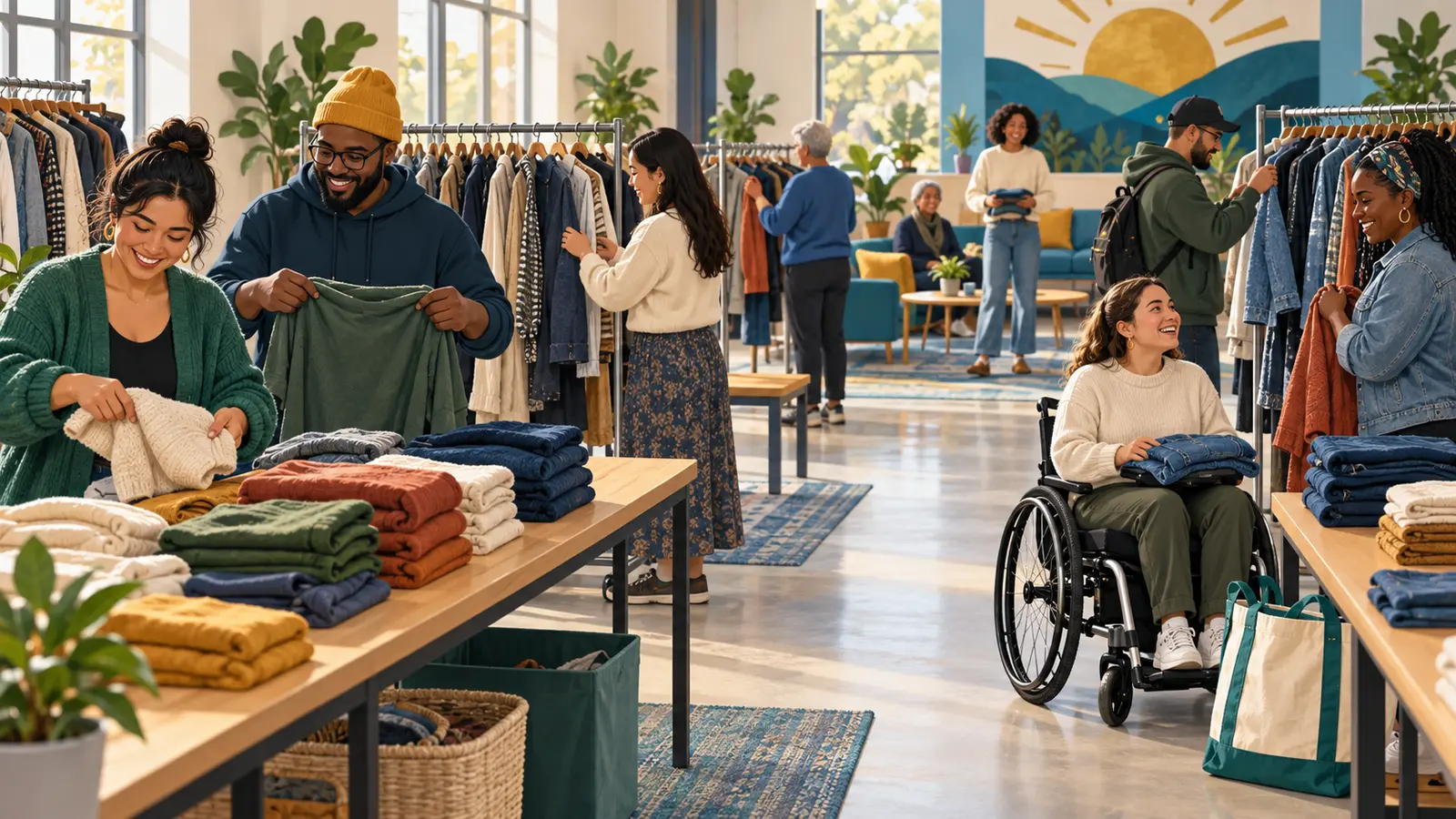
Walk through the venue as a participant would. Check the accessible entrance, route from parking or transit, door width, elevator access, restrooms, lighting, seating, temperature, and emergency exits. Keep routes wide and free of racks, bags, cords, and boxes.
Use stable tables and racks at reachable heights. Provide some seating, mirrors at varied heights when possible, a private fitting option if one is offered, and volunteers who can assist without taking control. Allow a support person to accompany a participant.
Share sensory information in advance: expected crowd size, music, fluorescent lighting, fragrances, and whether a quieter shopping time is available. Avoid spraying clothing with fragrance.
UWP’s accessible community event guide provides a broader checklist for communication, mobility, sensory, and participation access.
Separate intake from shopping so new arrivals do not block the entrance. Create a clear flow:
Use large, high-contrast signs and plain language. Do not rely only on color to mark sections. Size labels vary widely, so organize them as navigation aids rather than guarantees of fit. Avoid gender-policing who may browse a section; let participants choose what works for them.
Useful roles include event lead, venue contact, greeter, intake reviewer, sorter, floor guide, accessibility contact, bagging helper, crowd monitor, cleanup lead, and leftover coordinator. Write a short description for each role and identify who can make an exception or pause intake.
Train volunteers to:
For additional planning, see UWP’s guides on creating a volunteer orientation and recruiting volunteers.
Do not require people to explain financial need, disclose a clothing size publicly, or pose for photos. Ask before photographing the event, provide a clear no-photo option, and avoid images that reveal names, labels, children, or personal stories without informed permission.
If contact information is collected for reminders or feedback, explain why, collect only what is necessary, store it securely, and do not add people to another list without consent.
Use welcoming language such as “take what you can use” instead of framing participants as recipients of unwanted goods. A swap works best when everyone’s time and choices are respected.
Provide handwashing access or sanitizer, trash and recycling containers, first-aid supplies appropriate to the venue, and a way to isolate items that are wet, heavily soiled, or otherwise unsuitable. Keep food and drinks away from clothing tables.
Do not make medical claims that an item is allergy-free, sanitized, or safe for every person. Participants with fragrance, fiber, skin, or other sensitivities should be able to inspect items and decide what is appropriate for them.
If the event includes children’s products beyond ordinary clothing, research the specific safety and recall considerations before accepting them. Car seats, sleep products, helmets, and other safety equipment should not be casually added to a clothing swap.
Before promoting the event, ask any intended thrift store, shelter, recycler, school, textile program, or nonprofit exactly what it will accept, when, in what condition, and in what volume. Do not assume an organization can absorb an event’s leftovers.
Separate wearable items, recyclable textiles accepted by a confirmed program, and waste according to local rules. Budget time, containers, vehicles, and disposal responsibility. Do not leave bags outside a closed organization or put damaged textiles into a recycling bin unless the local program accepts them.
The EPA’s community waste-reduction guidance recommends reuse and donation of usable goods, and its textiles data page explains how clothing enters the municipal waste stream. Use current local instructions for the actual handoff.
A practical event notice should state:
Offer information in readable digital and print formats. Use descriptive link text, captions for video, adequate contrast, and a phone or email alternative when possible.
After the event, record operational measures you can verify: number of participants if counted consistently, items accepted, items exchanged, leftover categories, volunteer hours, access requests, and common questions. Do not convert bags or garments into environmental or economic impact claims without a documented method.
Ask participants what made the event easier, what created confusion, and whether the rules felt fair. Use the feedback to change one or two parts before repeating the event.
Explore UWP’s Community Outreach, Volunteer, Partners, and Resources pages for other ways to strengthen accessible community participation.
Participants bring accepted clothing, volunteers review and sort it, and people choose items under the event’s stated exchange rules. Bringing items does not have to be required if the organizer chooses an open-access model.
Set a number based on venue space, volunteer capacity, storage, and the leftover plan. A smaller, clearly stated limit is easier to manage than unlimited drop-off.
Ask participants to bring clothing clean, dry, and ready to wear. Organizers should not promise that all items are sanitized or suitable for every sensitivity.
Use a written plan confirmed with each intended recipient. Separate wearable items, locally accepted textile recycling, and waste, then complete the handoff during approved hours.
It can, if the organizer clearly explains the purpose, provides accurate terms, and follows venue and legal requirements. Do not imply a charitable donation or tax deduction without authority.
Choose an accessible route and restroom, keep aisles wide, provide seating, use readable signs, offer assistance without pressure, share sensory information, and provide a contact for accommodation requests.
Yes, ordinary children’s clothing can be a defined category under the same condition standards. Be cautious about accepting safety equipment or regulated products that require separate recall and condition checks.